Knowledge guide
Quang Tri Liberica and Excelsa Coffee Sourcing
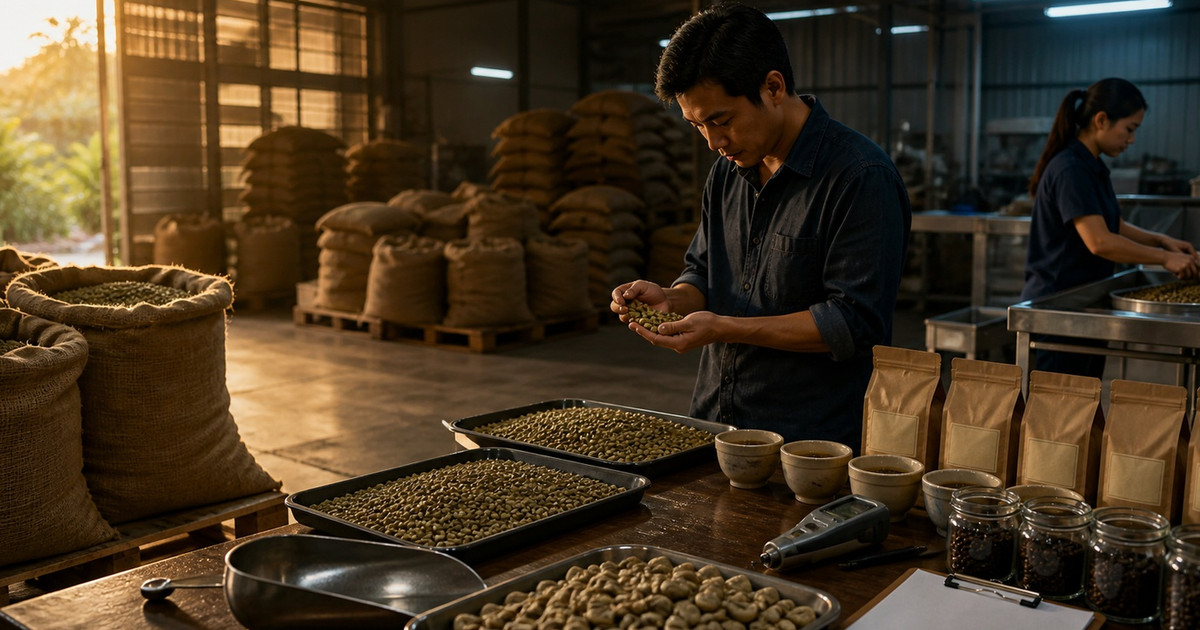
Source Quang Tri Liberica and Excelsa with help researching farms, checking lots, coordinating samples, and identifying roaster specialists in Vietnam.
Answer first
I am from Quang Tri and can help buyers research and approach coffee farms, processors, and roaster specialists in the province. The practical starting point is a clear buyer brief and a sample, not a promise that a particular bean, contact, or volume is always available.
For Liberica, Excelsa, Arabica, or other distinctive Quang Tri lots, I can help identify and approach suitable contacts, ask farm and lot questions in Vietnamese, check current availability, coordinate samples, and research roasters who understand the species and processing style.
If you already know your target, send me the species or trade name, green or roasted format, sample size, expected order volume, destination country, and preferred cup profile. If you do not know yet, I can help turn a broad idea such as “a special coffee from Quang Tri” into a shortlist that can be checked.
Why Quang Tri coffee is attracting specialty buyers
Quang Tri has a long coffee history around Khe Sanh and Huong Hoa. In November 2025, Vietnam's Intellectual Property Office granted the Khe Sanh geographical indication for Arabica coffee in green-bean, roasted-bean, and ground forms.[1] That protection gives buyers a useful origin reference, but its scope matters: it covers the specified Arabica products, not every coffee sold under a Khe Sanh or Quang Tri story.
Quang Tri's agricultural extension centre has documented a move toward quality-focused specialty production and closer coordination among farmers, processors, and purchasing businesses.[2] This does not make every lot specialty grade, but it shows why lot-level questions now matter more than a province name alone.
Liberica and Excelsa are a different sourcing opportunity. The 96B Liberica and Excelsa Project reports working with five farming families in Quang Tri and testing natural, washed, honey, and controlled fermentation methods.[3] Crop to Cup's Vietnam tasting material documents group-attributed Liberica lots from Huong Phung, historically part of Huong Hoa district, including natural and 120-hour anaerobic natural processing at about 600 metres elevation. The material identifies the 96B project group and five families, not individually named farms.[5]
A Rabbit Hole Roasters offer documents a Quang Tri Liberica lot sold through named import and export partners, with the farm group, process, and location attached to the offer.[7] Coffee Review also evaluated a Khe Sanh Valley anaerobic lot in August 2026 and described the exact producer, process, and cup assessment rather than treating “Vietnamese Liberica” as one standard flavour.[6]
That is the useful signal for a buyer. The region has active farmers and processors, unusual coffee material, and evidence of international specialty interest. Supply still needs to be checked lot by lot.
Liberica, Excelsa, and ca phe mit: get the name straight before buying
Coffee names can become confusing quickly. In March 2026, Báo Quảng Trị reported that the provincial Department of Agriculture and Environment had recognized 69 source trees under the name ca phe mit (Liberica) in Huong Phung.[8] That official local label does not prove that every lot sold as ca phe mit, Liberica, or Excelsa has the same botanical identity.
Scientific treatment has also changed. A 2025 Kew-led genomic study published in Nature Plants supports treating Liberica and Excelsa as two species, Coffea liberica and Coffea dewevrei.[4] Older references and some current trade pages describe Excelsa as a variety of Liberica, often written as Coffea liberica var. dewevrei.[6]
A buyer does not need to settle the taxonomic debate before requesting a sample. The buyer does need to know what the farm, processor, and exporter mean by the name on the offer.
Ask for:
- The species or cultivar name used by the farm
- The Vietnamese local name
- Farm and tree photos where available
- Current commune and province, with the former district or historical locality recorded separately when useful
- Harvest period and crop year
- Whether the lot is a single type or mixed local cultivars
- Cherry selection and processing method
- A green and roasted sample for comparison
Keep the seller's exact identification in the lot record. Do not quietly change “Excelsa” to “Liberica” or the other way around in your product page.
What I can help buyers source in Quang Tri
Availability changes with the harvest and with each farm's processing plan, but the search can cover several practical formats.
Green coffee samples and small specialty lots
This is suitable for importers, independent roasters, competition-focused teams, and product developers who want to evaluate the coffee with their own roast profile. The first request should state the sample quantity, expected follow-on volume, destination, and whether you need natural, washed, honey, anaerobic, or another process.
Roasted samples from local specialists
A local roast sample can show how a Quang Tri roaster currently presents the coffee. It is useful for sensory orientation, gifts, hospitality concepts, and buyers who are not ready to import green beans. It should not replace a green sample if you intend to roast commercially in your destination market.
Farm and processor introductions
Some buyers want a named farm. Others need a processor or cooperative that can combine cherry collection, drying, sorting, storage, and commercial communication. I can research potential contacts, identify which role each one appears to perform, and coordinate an introduction subject to availability and response.
Roaster research and roast discussion
Liberica and Excelsa do not automatically behave like a familiar Arabica lot. Bean size, density, moisture, processing, and desired brew method affect the roast approach. I can research and approach suitable roaster specialists for sample roasting, profile discussion, or a locally roasted product.
Origin visits and sample coordination
For a serious project, a visit can help confirm the farm setting, processing equipment, drying method, storage, and people behind the lot. A visit should have a written agenda so it produces useful sourcing information rather than only photos.
The buyer brief I need
A good first message can be short, but it should answer the questions below.
| Buyer question | Example answer |
|---|---|
| What do you want? | Liberica or Excelsa green coffee for filter roasting |
| What is the use? | Seasonal single-origin release for an independent roastery |
| What sample do you need? | 300 to 500 grams of green coffee per lot |
| What volume may follow? | 30 kg test order, then 200 kg if the sample works |
| Where will it go? | Singapore, Germany, the United States, or another named market |
| Which process interests you? | Natural, washed, honey, anaerobic, or open to comparison |
| What cup direction do you want? | Fruit-forward filter, lower-fermentation espresso, or an unusual competition lot |
| What documents matter? | Invoice, packing list, origin information, phytosanitary or residue documents where required |
| What is your timing? | Sample by a named date and commercial shipment window |
If the answer to volume is “not sure,” say whether you are exploring a retail sample, a cafe release, a wholesale roast, or an import relationship. That still gives farms and roasters something concrete to respond to.
How I check a potential lot
I use a sample-first sourcing process. It does not certify the coffee, but it makes the unknowns visible before a larger commitment.
1. Confirm who controls the coffee
The contact may be a farmer, cooperative, processor, roaster, exporter, or a combination of these roles. I record who grew the cherries, who processed them, who currently holds the coffee, the proposed invoicing entity, and the proposed exporter of record. I request supporting documents where relevant and refer destination compliance questions to the appropriate broker or qualified adviser.
2. Record the lot, not only the origin story
At minimum, the lot record should include:
- Producer or farm group
- Farm location
- Crop year
- Seller's species or cultivar label
- Process and fermentation details
- Drying method
- Available quantity
- Green or roasted format
- Bag or sample packaging
- Storage location
For green coffee, ask for moisture, water activity, screen or size information, defect notes, and a representative sample when available. Requirements should match the destination market and order size.
3. Cup the actual sample
One online tasting note does not describe every Quang Tri Liberica or Excelsa. Processing can shift the cup substantially. A natural lot and a long anaerobic lot from the same area may need different roast treatment and appeal to different customers.
Use a repeatable cupping or brew protocol. Record roast date, rest time, water, grind, recipe, and evaluator notes. If two roasters are comparing the lot, share enough detail to understand why their results differ.
4. Check commercial and export readiness
Before discussing a larger purchase, confirm:
- Current stock and whether it is the same lot as the sample
- Minimum order and price basis
- Sample cost and courier method
- Packaging and storage
- Lead time
- Incoterm or domestic handover point
- Exporter of record
- Destination-specific documents and tests
- Payment recipient and invoice identity
For agricultural goods, the destination country's import, food-safety, residue, labelling, and plant-health requirements need to be checked for the exact product and shipment. A farm introduction alone does not solve customs compliance.
For a broader supplier-risk process, use my Vietnam supplier verification checklist.
A realistic sample-to-order workflow
- Buyer brief: define species, format, use, sample size, possible volume, destination, and timing.
- Local search: identify farms, processors, and roasters that plausibly fit the brief.
- Availability check: confirm current crop, lot, quantity, and who controls it.
- Traceability note: record origin, seller's botanical label, process, and commercial role.
- Sample coordination: arrange green or roasted samples with consistent labels.
- Cup and roast feedback: compare results and send specific questions back to the producer or roaster.
- Commercial check: review price, minimum order, packaging, documents, payment, and shipment route.
- Small first order: use a bounded test before assuming repeatable volume.
This workflow is slower than buying a product from a retail page, but it gives a commercial buyer better evidence.
What I will not promise
I will not claim that every Quang Tri farm grows Liberica or Excelsa, that a lot is available before checking, or that one sample represents the whole region. I also will not present a seller's species label, tasting notes, certification, geographical indication, or export status as verified unless the supporting information is available.
The Khe Sanh geographical indication is a good example. It is meaningful for the Arabica products within its registered scope.[1] A Quang Tri Liberica or Excelsa lot needs its own origin, producer, process, and commercial evidence. The same discipline protects the buyer and the farm.
Work with a local Quang Tri sourcing contact
Quang Tri is my hometown. My role is to research local options, approach potential contacts, translate the buyer's questions, and coordinate introductions when both sides agree.
Unless separately agreed and verified for a specific order, I am not the coffee seller, exporter of record, customs broker, laboratory, certifier, or payment intermediary. Those roles, invoices, and responsibilities must be named before money or goods move.
After your first brief, my initial output can be a short decision note covering plausible contacts, what each contact does, current sample or lot status, unanswered questions, and the next recommended check. If there is a viable match, I can then coordinate the introduction and sample request.
I can help with: - Farm, processor, cooperative, and roaster research and outreach - Vietnamese and English outreach - Current-lot and sample questions - Introductions and call coordination - Sample tracking - Roaster-specialist research - Quote and requirement comparison - Written risk notes before an order
I do not route every request to the same supplier. The goal is to find the right route for the buyer's use case and make clear what has and has not been verified.
Send your brief through Vietnam sourcing services or contact Nguyen LNP on Telegram at @nguyenlnp. For a broader view of the process, see how to source products from Vietnam.
FAQ
Can you find Liberica or Excelsa coffee farms in Quang Tri?
I can research and contact plausible farms, farm groups, processors, and cooperatives, then check current lot and sample availability. Availability, species identification, process, and volume still need confirmation for the current crop.
Can I buy green coffee for my roastery?
Potentially, yes. Start with your destination, sample size, expected commercial volume, process preference, and timing. Export readiness and documentation must be checked before a commercial shipment.
Can you connect me with a roaster in Quang Tri or Vietnam?
I can research and approach suitable roaster specialists for sample roasting, roast-profile discussion, or a locally roasted product. Any introduction depends on availability and response. The best route depends on whether you want filter, espresso, retail packaging, competition preparation, or wholesale production.
Is Excelsa the same as Liberica?
Names vary between scientific and trade sources. A 2025 genomic study supports treating them as separate species, while older references and some sellers describe Excelsa as a Liberica variety.[4][6] Keep the supplier's exact label and verify the actual lot rather than relying on the product name alone.
Is all Khe Sanh coffee protected by a geographical indication?
No. The Khe Sanh geographical indication granted in 2025 applies to Arabica coffee in specified green, roasted, and ground forms.[1] Do not assume that a Liberica or Excelsa lot is covered.
What should I send in my first message?
Send the bean or species name if known, green or roasted format, sample quantity, possible order volume, destination country, preferred process or cup profile, and timing. Photos or examples of coffees you already like are also useful.
Sources
[1] https://ipvietnam.gov.vn/vi/web/english/news-events/-/asset_publisher/ZMuTgR44COLR/content/geographical-indication-protection-khe-sanh-for-coffee-products/pop_up | IP Vietnam: Geographical indication protection Khe Sanh for coffee products [2] https://khuyennong.quangtri.gov.vn/mo-hinh-kinh-nghiem/huong-di-rieng-ca-phe-quang-tri-1074.html | Quang Tri Agricultural Extension: A distinct direction for Quang Tri coffee [3] https://96b.coffee/liberica-project | 96B Coffee: Liberica Project [4] https://pmc.ncbi.nlm.nih.gov/articles/PMC12449269 | Nature Plants: Genomic data define species delimitation in Liberica coffee [5] https://showroomcoffee.com/vietnamtastingkit | Showroom Coffee: Vietnam Tasting Kit [6] https://coffeereview.com/review/roasted-madam-huongs-khe-sanh-valley-120-hour-fermentation-shade-coffee | Coffee Review: Madam Huong's Khe Sanh Valley [7] https://rabbitholeroasters.com/products/liberica-natural-vietnam | Rabbit Hole Roasters: Liberica Vietnam [8] https://baoquangtri.vn/kinh-te/202603/cong-nhan-69-cay-ca-phe-mit-dau-dong-bbf7987 | Quang Tri Newspaper: 69 ca phe mit source trees recognized
Need help applying this?
See the related service page: Vietnam sourcing services for importers or email [email protected].